Quick answer
Get the Bambu Lab A1 mini: it calibrates itself, runs at or under 48 dB in quiet mode — conversation volume — and its desk-sized footprint fits apartment life. If you already know you’ll print bigger than its 180 mm cube, step up to the full-size Bambu Lab A1 — same quiet, same auto-calibration, 256 mm build volume. And if kids, pets, or shared air are the deciding factor, the enclosed Flashforge Adventurer 5M Pro puts the hot parts behind a door and adds filtration for less than enclosed machines used to cost.
Our verdict
- Best apartment starter printer
- Bambu Lab A1 mini — ~$200–300 (check current)Check price on Amazon
- Bigger builds, same quiet
- Bambu Lab A1 — ~$220–300 (check current)Check price on Amazon
- Enclosed pick for kids and shared air
- Flashforge Adventurer 5M Pro — ~$340–450 (check current)Check price on Amazon
The picks
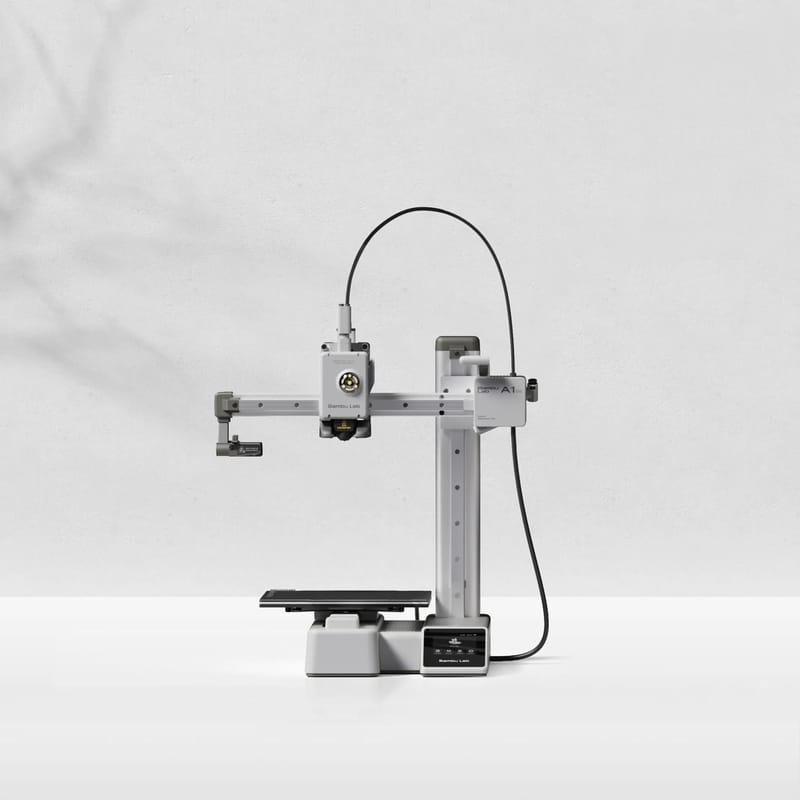
Bambu Lab A1 mini
Quiet, beginner-proof 3D printer sized for apartment desks.
- 180 × 180 × 180 mm build volume
- Full-auto calibration, ≤48 dB quiet mode
- Open frame; best with PLA and PETG
~$200–300 (check current)
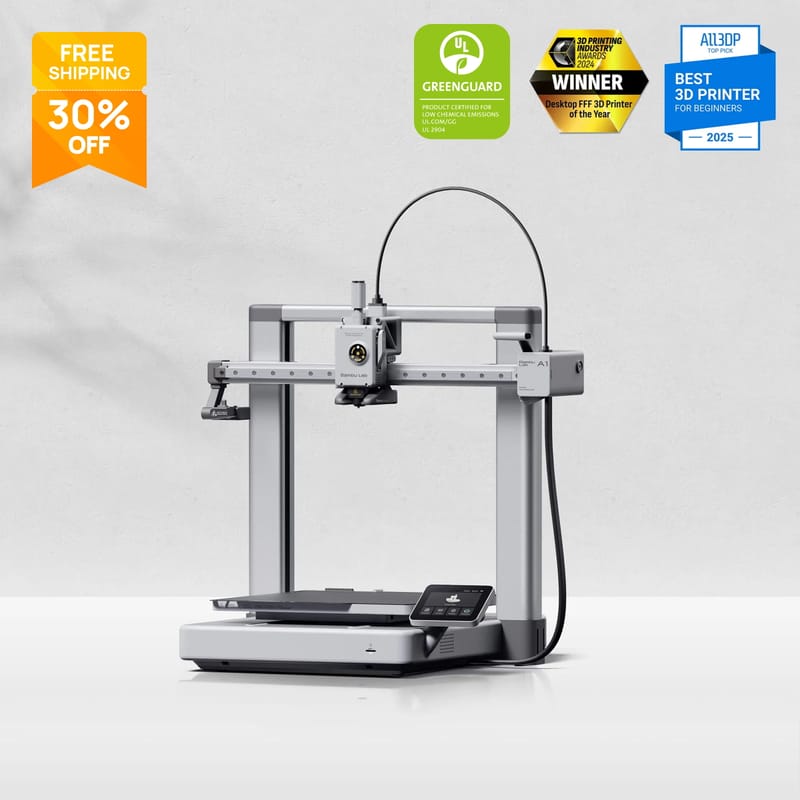
Bambu Lab A1
The A1 mini’s big sibling — same quiet, more build room.
- 256 × 256 × 256 mm build volume
- Full-auto calibration, ≤48 dB with noise cancellation
- Multi-color capable with optional AMS lite
- Open frame; best with PLA and PETG
~$220–300 (check current)
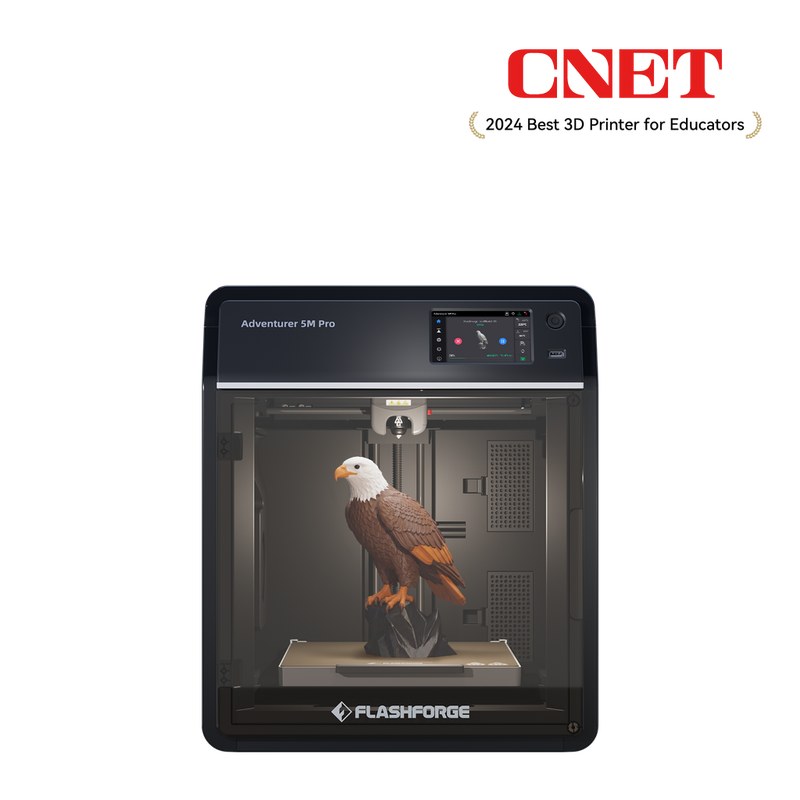
Flashforge Adventurer 5M Pro
The enclosed pick when kids, pets, or shared air decide it.
- 220 × 220 × 220 mm enclosed build volume
- HEPA + activated carbon filtration
- Manufacturer-rated 50–55 dB by mode
- CoreXY with full-auto one-click leveling
~$340–450 (check current)
Between the two Bambus, size is the whole decision. The mini’s 180 mm cube covers most household prints — organizers, hooks, toys, replacement parts — on a desk corner. The A1’s 256 mm cube handles helmets, larger enclosures, and one-piece prints you’d otherwise split, but it wants a sturdy table of its own. The Flashforge changes the question from size to safety: an enclosed CoreXY with a HEPA + activated-carbon filter, for households where an open frame’s exposed hot parts are a dealbreaker.
Who should skip which:
- Skip the A1 mini if you already know you’ll print bigger than 180 mm, or if an open frame’s reachable hot parts rule it out for your household.
- Skip the A1 if desk space is tight or you’d rarely use the extra volume — it shares the mini’s open-frame limits, just bigger.
- Skip the Adventurer 5M Pro if quiet is your top priority — its manufacturer rating is 50–55 dB by mode and owner reports run higher under load, versus the Bambus’ ≤48 dB. Its software and app experience also trail Bambu’s, it weighs 20 kg, and many owners print PLA with the door open anyway, which gives up the containment you paid for.
What apartment-friendly actually means
3D printer priorities by apartment situation
| Situation | What to prioritize | Why | Watch out for |
|---|---|---|---|
| Shared walls and evenings | Noise under ~50 dB | Printers run for hours; loud ones carry through walls | Older bed-slinger designs without noise modes |
| Limited desk space | Small footprint, no separate parts dryer to start | A mini printer fits a bookshelf-depth desk | Filament storage sprawl — one dry box is enough |
| Kids in the home | An enclosure, or PLA-only supervised use on an open frame | Nozzles run above 200°C and beds get hot | Open frames put hot parts within reach — an enclosed door helps, but supervision rules still apply |
| Fume concerns | PLA filament + a window you can open | PLA emits less odor than ABS/ASA | Any printer marketing that claims zero emissions |
| First printer, unsure commitment | Auto-calibration | Manual bed leveling is where beginners quit | Cheap kits that need constant tuning |
When an enclosed printer earns it
Enclosed printers contain heat, fingers, and some particles better, and they unlock ABS/ASA materials. They also used to cost two to three times more than open-frame machines — that’s no longer true, and the Adventurer 5M Pro is why we now carry an enclosed pick at all: at ~$340–450 it sits close to the full-size A1’s price while putting every hot part behind a door.
Two honest limits before you pay for an enclosure. First, its HEPA + activated-carbon filtration numbers are the manufacturer’s own — treat the filter as a supplement to ventilation, never a substitute, and read the ventilation guide before the first print regardless. Second, an enclosure only contains what’s actually closed: many owners print PLA with the door open for better cooling, at which point you’ve bought a heavier, louder open-frame printer. If your household doesn’t specifically need the physical barrier or ABS/ASA capability, the open-frame Bambus with strict room rules remain the simpler buy.
House rules that make it family-safe
Treat the printer like a hot appliance, not a toy: it lives in a ventilated room kids don’t play in, prints run while an adult is home, and the nozzle and bed are off-limits until fully cooled. Kids can do the fun parts — picking models, watching first layers, removing cooled prints — without touching the hot end.
Sources checked
FAQ
Is a 3D printer too loud for an apartment?
The A1 mini’s quiet mode runs at or under 48 dB — about conversation level — which shared walls handle fine. Print during waking hours anyway; even quiet printers hum for hours.
Is PLA safe to print indoors?
PLA is the lowest-odor common filament, but every filament emits ultrafine particles when heated. Print in a room with airflow, keep the door closed to bedrooms, and don’t sleep next to a running printer.
Can kids use a 3D printer?
With an adult running the hot parts, yes — modeling and watching prints is great for kids. Nozzles exceed 200°C, so unsupervised use is a hard no in our house rules.
Do I need an enclosed 3D printer in an apartment?
Need, no — an open-frame printer with PLA, ventilation, and room rules works for most homes. The enclosure earns its price when small kids or pets share the space, when you want a physical barrier rather than a rule, or when a project genuinely requires ABS/ASA. Its filter helps but doesn’t replace an open window.