Quick answer
Buy the GoveeLife Water Leak Detector 1s kit: three battery sensors, a Wi-Fi gateway, and phone alerts the moment water touches a probe. Leak sensors are the most renter-friendly device on this site — they sit on the floor, install nothing, and a $50 kit can flag the kind of slow leak that eats a security deposit.
Our verdict
- Best leak sensor kit
- GoveeLife Water Leak Detector 1s — ~$40–55 (check current)Check price on Amazon
The kit to buy
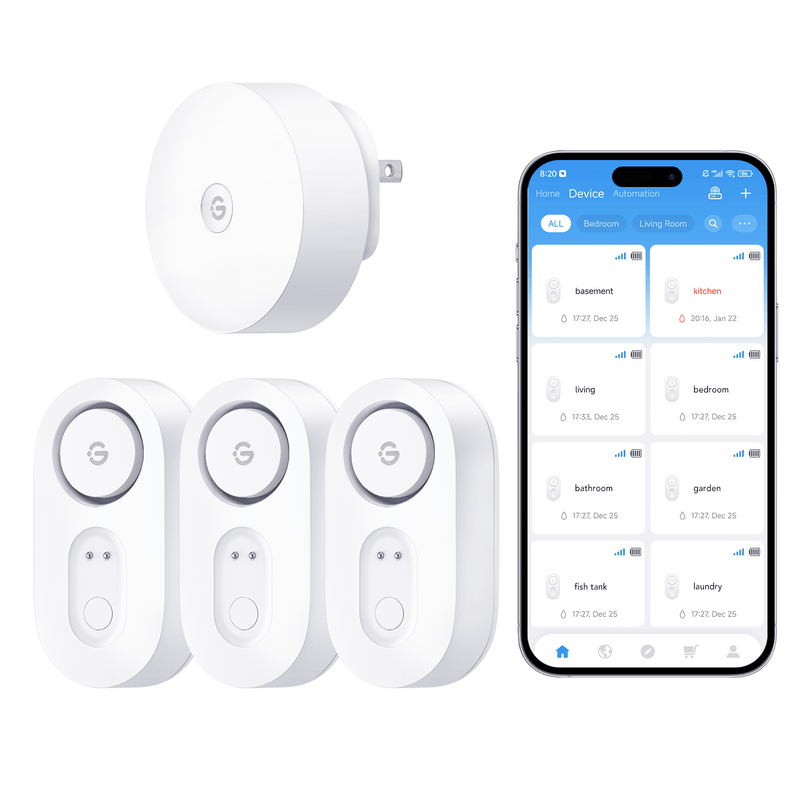
GoveeLife Water Leak Detector 1s
Phone alerts before a small leak becomes a deposit problem.
- 3 battery sensors + 2.4 GHz Wi-Fi gateway
- 105 dB alarm plus app, SMS, and email alerts
- Up to 5-year sensor battery life
~$40–55 (check current)
If the alarm needs to be somewhere other than the leak
The Govee kit puts the 105 dB alarm on the sensor itself. That is fine when the sensor is ten feet from where you sleep. It is worth less if the sensor is behind a closed cabinet at the other end of the apartment and your phone is on Do Not Disturb overnight.
The X-Sense SWS54 kit answers that specific problem: the base station is a second alarm you place yourself. Sensors sit where water pools and reach the base over a 915 MHz radio rather than Wi-Fi, so the base can live in the hallway or bedroom and still hear them. Same price bracket, not an upgrade — a different tradeoff.
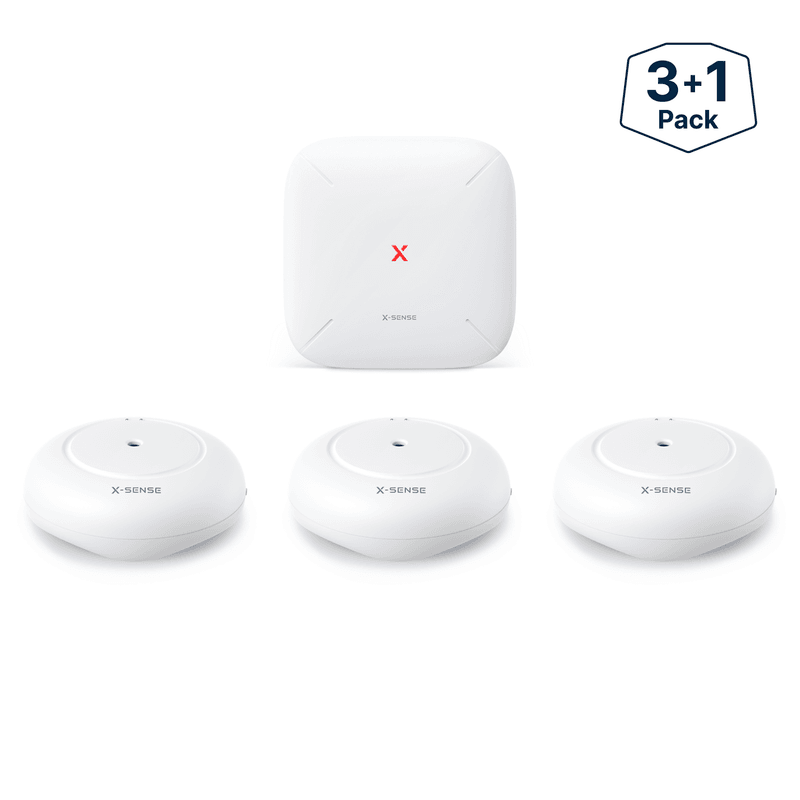
X-Sense SWS54 Water Leak Detector Kit
The base station is a second alarm you place yourself — sensor under the sink, noise in the bedroom.
- 3 floor sensors (110 dB) plus a plug-in base station (100 dB)
- Sensors reach the base over 915 MHz, so only the base needs Wi-Fi
- 2 × AAA per sensor, 3-year battery life, IP66
~$45–55 (check current)
Where it loses: the sensors are rated IP66 against the Govee’s IP67, the batteries are quoted at three years against five, and the base station needs a mains outlet you may not have spare near the kitchen. If you want the fewest objects plugged in, stay with the Govee kit.
One correction worth carrying into the store: the Amazon listing for this kit advertises “120 dB” and an 1804 ft range. X-Sense’s own spec sheet says 110 dB at the sensor, 100 dB at the base, and 1,640 ft of open-air connection distance. We use the manufacturer’s numbers throughout — including on the Govee kit, whose marketing quotes the same 1804 ft figure.
Where water shows up first
Put sensors where water would pool first, not where they look tidy.
Apartment leak sensor placement
| Situation | Why it leaks | Where the sensor goes | Renter note |
|---|---|---|---|
| Under the kitchen sink | Supply lines and drain joints loosen over time | Flat on the cabinet floor, under the trap | The most common first leak in older units |
| Washer or laundry hookup | Hoses and connections fail under pressure | Behind the machine, at the lowest floor point | Check in-unit laundry hoses when you move in |
| Water heater closet | Tanks weep from the base before they fail | On the drip pan or floor beside the base | Only if the closet is accessible to you |
| Toilet base and bathroom sink | Wax rings and supply valves drip slowly | Beside the base, against the wall line | Slow drips here often go unnoticed for weeks |
| Dishwasher and fridge line | Door seals and ice-maker lines drip behind appliances | As far under or behind as the sensor fits | A sensor cable variant reaches tighter spots |
Five-minute setup that actually protects you
Leak sensor placement checklist
- Plug the gateway into an outlet central to your riskiest spots.
- Name each sensor by location in the app before placing it.
- Put sensors probe-side down, flat on the floor at the lowest point.
- Test one sensor with a few drops of water so you know what an alert looks like.
- Tell whoever else lives with you what the 105 dB alarm means.
Short-term and vacation rentals: the case is stronger
The same kit solves a bigger problem for a host or property manager: nobody’s there to notice a slow leak between stays. A gateway-connected sensor is the difference between catching a supply-line drip the same day and finding a soaked subfloor at the next turnover.
Leak sensors for unattended rental units
- Put the gateway on a plug that stays powered between guest stays — not a switched outlet a cleaner might turn off.
- Add the host or property manager's phone to the app, not just the on-site contact.
- Prioritize appliance connections over fixtures: ice makers, in-unit washers, and dishwashers cause the most unattended damage.
- Check the app for a missed-alert or offline notification, not just leak alerts — a dead gateway cannot warn you either.
What leak sensors do not do
A sensor warns you; it does not shut off water, stop a burst pipe, or repair anything. When one alerts, close the fixture’s supply valve if you can reach it safely, then call building maintenance — apartment water shutoffs and anything behind walls are the property’s job, not yours. Report leaks in writing so there’s a record.
Sources checked
- GoveeLife Smart Water Leak Detector official page
- X-Sense SWS54 Water Leak Detector Kit official page
FAQ
Do leak sensors need Wi-Fi?
The sensors themselves talk to the included gateway, and the gateway needs 2.4 GHz Wi-Fi for phone alerts. Without Wi-Fi you still get the loud local alarm.
How many sensors does an apartment need?
Start with three: kitchen sink, bathroom, and laundry or water heater — whichever you have. Add more only for spots with a real water source.
Will a leak sensor lower my renters insurance?
Don’t count on it. Policies vary, and we make no insurance claims here — the value is catching a leak early enough to protect your belongings and your deposit.
Which leak sensor kit should I pick?
Start with the GoveeLife 1s: higher waterproof rating, longer quoted battery life, and the smallest number of things to plug in. Choose the X-Sense SWS54 instead if you need the alarm somewhere other than the leak — its base station sounds alongside the sensor, so you can put the noise in the bedroom and the sensor under the sink.
Are leak sensors worth it for a short-term or vacation rental?
Often more so than for an owner-occupied apartment. A unit that sits empty between guests has nobody to notice a slow drip, so a phone alert can catch damage days or weeks earlier than a walk-through would. The same battery-and-gateway kit works — just make sure the gateway stays on a constantly-powered outlet and the host or manager is added to the alert list, not only an on-site contact.